
Abatement Technologies Air Duct Cleaning in Stanton: A Homeowner’s Guide
Most homeowners never look at the machine sitting in their hallway during a duct cleaning. It either captures particles down to 0.3 microns or it blows them back into the room, and that one specification decides whether the job cleaned your air or just moved the dust around. Abatement Technologies equipment is built for the first outcome. If you’d rather skip the guesswork and talk to someone who uses it, call (877) 820-9417.
What Are Abatement Technologies Machines, Exactly?
Abatement Technologies builds HEPA negative-air units. In plain terms, these are industrial air movers with a high-efficiency particulate air filter that traps particles at 0.3 microns and larger, and they’re designed to run under negative pressure. The machine sits in a room, seals against a doorway or duct opening, and pulls air toward itself instead of letting it drift. That’s the whole idea: air goes in, debris stays in the filter, clean air comes out the exhaust. Nothing gets redistributed into the rest of the house.
These units are rated in CFM, or cubic feet per minute, which tells you how much air the machine can move. Higher CFM means a stronger pressure differential, which matters when you’re pulling loose dust and debris out of a long run of ductwork rather than just the register right above the machine. In our experience with Stanton homes, the CFM rating and the filter class are the two numbers worth asking about before any work starts.
This is the same category of equipment used in mold remediation and restoration work, which is exactly why it earns its place in a residential duct cleaning setup. It’s not a shop vac with a fancy label. It’s a containment tool.
Why the Pressure Differential Matters More Than the Brush
Here’s the part most people miss. Agitation alone doesn’t clean a duct system. A rotary brush loosens debris from the walls of the ductwork, but if there’s no negative pressure pulling that loosened material out, you’ve simply made the dust airborne inside the system. It settles somewhere else and the job looks clean from the outside while the air quality hasn’t changed.
The two-step process that actually works looks like this:
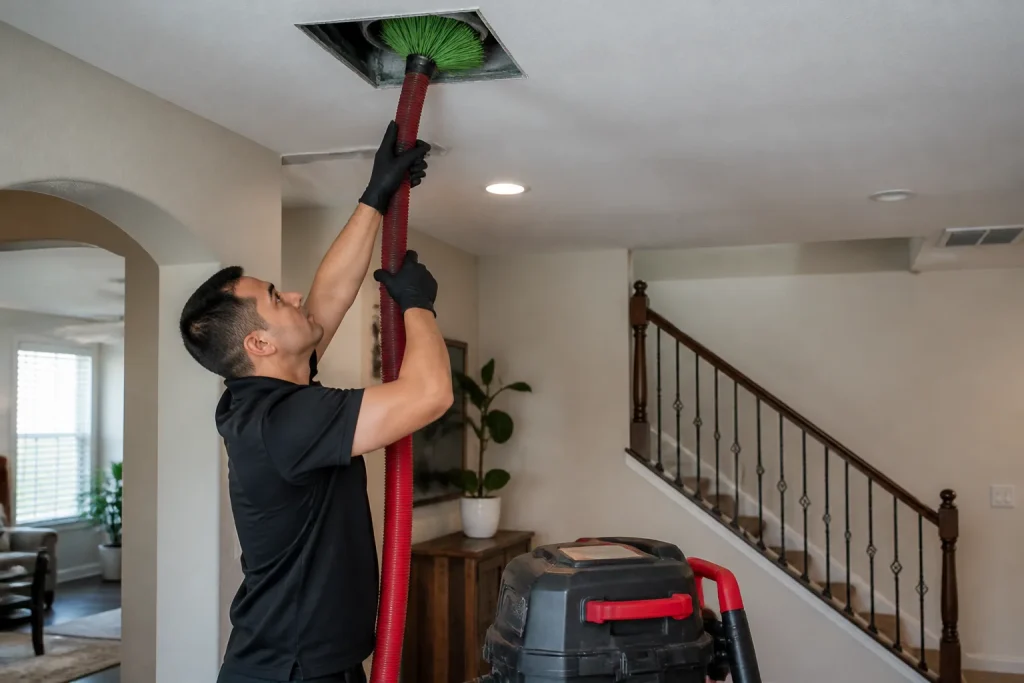
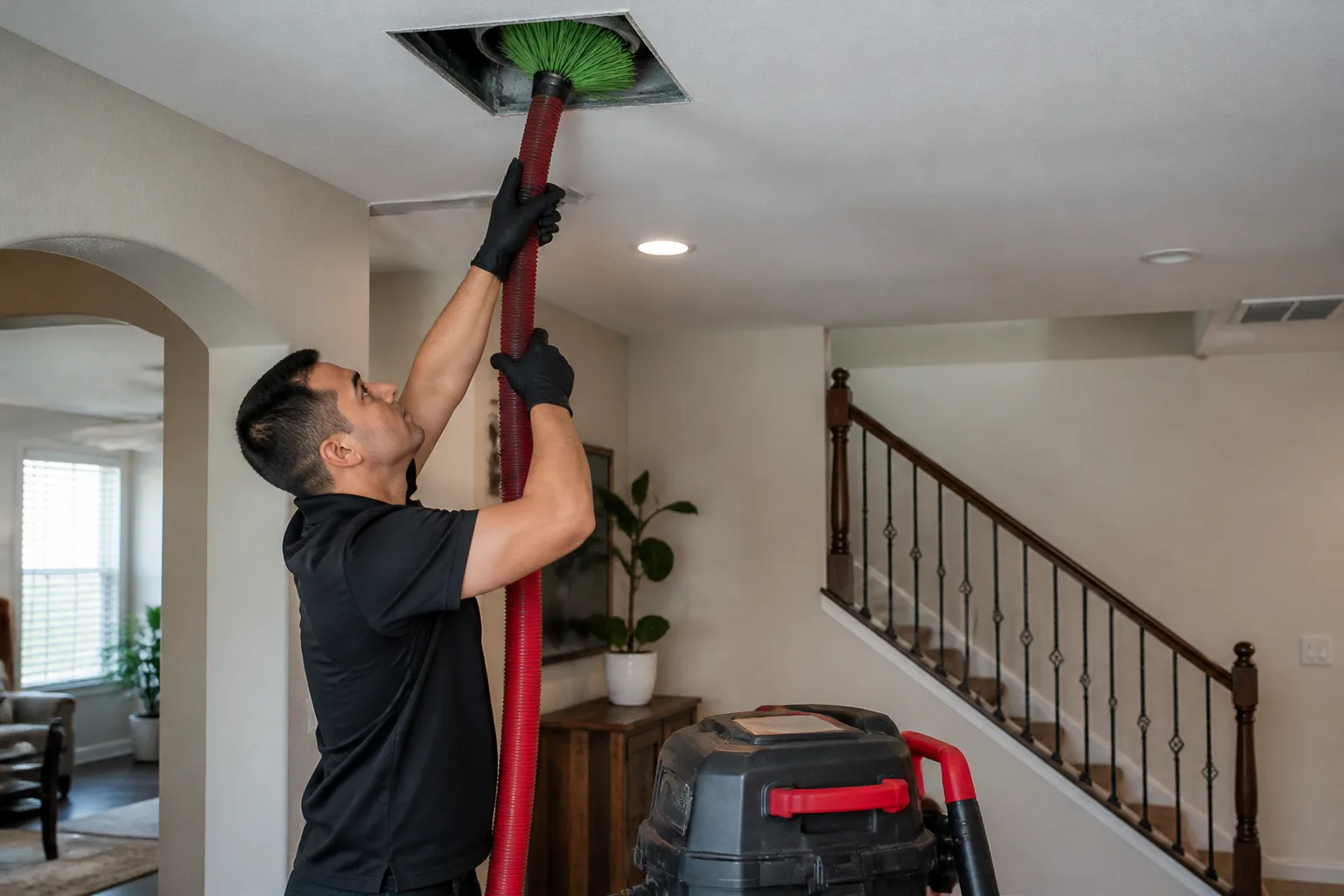
- Agitation. A rotary brush system like Rotobrush scrubs the interior surfaces of the ductwork, breaking debris loose from the walls.
- Extraction under negative pressure. A HEPA negative-air unit like an Abatement Technologies machine holds the system under vacuum so the loosened material travels to the filter instead of into your living room.
Run those in the right order, with the containment running the whole time, and you’ve got a mechanical process you can defend. Run a brush without real extraction and you’ve got a homeowner who paid for a service and can’t tell whether anything happened. That’s why we pair Rotobrush agitation with Nikro negative-air extraction and Abatement Technologies filtration on the jobs we handle in Stanton.
When Higher-Grade Containment Isn’t Optional
For a routine cleaning in a home with no special concerns, a decent negative-air setup does the job. But there are specific situations where a HEPA-rated unit stops being a nice-to-have and becomes the only reasonable choice.
- Post-renovation dust. Drywall dust, silica, and fine construction particulate get pulled deep into ductwork during a remodel. That material is exactly what a HEPA filter at 0.3 microns is built to capture.
- Mold-adjacent cleaning. If there’s any indication of moisture problems or microbial growth near the system, you want the same containment class used in remediation work, not a standard vacuum.
- Homes with immunocompromised occupants. When someone in the household has a compromised immune system or a serious respiratory condition, the margin for redistributed particulate is zero.
In those cases, ask what equipment is being used. A straight answer with a brand name and a filter class is a good sign. A vague “we use advanced equipment” is not. And if the work involves anything beyond routine cleaning, a trained professional should be the one handling it, not a homeowner with a rented machine.
What “HEPA Filtration” Actually Means on a Spec Sheet
“HEPA” gets used loosely in marketing. On a real spec sheet, it means a filter rated to capture 99.97% of particles at 0.3 microns, the size that’s hardest to trap. On a sales page, it can mean almost anything. Here’s how to tell the difference:
- Ask for the filter’s efficiency rating and the particle size it’s tested at. A real HEPA claim comes with both.
- Ask for the CFM rating of the machine. A high-efficiency filter on a weak blower doesn’t move enough air to create real negative pressure.
- Look for a brand you can verify. Abatement Technologies, Nikro, Rotobrush, Honeywell, and Aprilaire are names any HVAC technician recognizes. That recognition matters.
We work with systems that use Honeywell and Aprilaire filtration and purification products, so we’re used to reading these specs for a living. It’s a reasonable thing for any homeowner to ask about before booking.
Why Stanton’s Housing Stock Makes This Equipment More Relevant
Stanton is a dense, older-built city, and that changes what a duct cleaning job actually involves. Homes built decades ago often have ductwork that’s been added to, patched, or rerouted over the years. That means more seams, more joints, and more places for debris to collect and for air to leak. Older construction also means remodels and repairs happen in occupied homes, which is exactly the post-renovation dust scenario where HEPA containment earns its keep.
Proximity to industrial corridors adds another layer. Fine particulate from outside doesn’t stay outside if the system is pulling it in through leaky returns. That’s part of why duct repair and sealing sits alongside cleaning in the work we do in Stanton: a system that leaks will keep pulling in whatever’s in the air regardless of how well it was cleaned.
None of this makes a routine cleaning less valuable. It just means the equipment spec matters more here than it might in a newer suburban subdivision with tighter, simpler ductwork.
How to Evaluate Any Duct Cleaning Quote in Stanton
A fair quote names what equipment will be used, how containment will be handled, and what the final price covers. A quote that leads with a low number and adds items once the technician is on site is the pattern worth avoiding. Here’s what to look for:
- Specific equipment brands named, not vague descriptions.
- Confirmation that negative pressure runs for the duration of the job, not just at the start.
- A flat price per system agreed before work begins, rather than per-vent pricing that climbs with every register.
- Before-and-after photos of your own ducts, so you can see the work instead of taking it on faith.
That last point matters more than people think. A photo of your ductwork before and after is verifiable. A verbal assurance that the job went well is not. The local pro is licensed and insured as their state requires, and asking to see that documentation is fair game.
When to call a pro
If you can smell something musty when the system kicks on, if allergy symptoms spike indoors, if you’ve just finished a renovation, or if a recent inspection flagged the ductwork, it’s time. Containment equipment, agitation tools, and the know-how to run them together are not things most homeowners want to rent and learn. Call (877) 820-9417 for a free estimate. We answer 24/7. Fast dispatch from 7am to 7pm, Sunday through Friday.
Related services in Stanton: air duct cleaning, HVAC cleaning, and dryer vent cleaning are all part of keeping a home’s air path clear and healthy. If you want the wider picture of how Stanton Air Duct Cleaning Pros approaches the full system, it starts with the equipment.
The Bottom Line
The equipment specification is the thing most homeowners never ask about, and it’s the thing that determines whether a duct cleaning improved your air or just moved the debris. HEPA-rated negative-air units like Abatement Technologies machines, paired with rotary agitation and run under real negative pressure, are the difference between a documented job and a claim you have to take on faith. In a city with Stanton’s older, denser housing stock and proximity to industrial corridors, that distinction matters more than it might elsewhere.
If you’re in Stanton and need help, Stanton Air Duct Cleaning Pros offers free estimates. Our technicians have up to 13 years of experience. Call (877) 820-9417. We answer 24/7. Fast dispatch from 7am to 7pm, Sunday through Friday.
Frequently Asked Questions
It refers to using Abatement Technologies HEPA negative-air machines during a duct cleaning job to hold the system under negative pressure and capture airborne debris at 0.3 microns rather than letting it redistribute into the home. The machines are the containment side of the job; rotary brushes like Rotobrush handle the agitation. Call (877) 820-9417 for a quote on equipment-matched cleaning in Stanton.
Pricing is set per system based on its size, layout, and condition, and the written estimate sets the final price. Beware of quotes that lead with a low teaser and add charges once the technician is on site. Ask for a flat price per system agreed before work starts. Call (877) 820-9417 for a free estimate.
Ask for before-and-after photos of your own ductwork. That’s the difference between a verifiable job and a verbal assurance. A company using named equipment (Abatement Technologies, Rotobrush, Nikro) is also more accountable to a specific process. Call (877) 820-9417 to book a cleaning with documented results.
Usually because they skip the containment step, use a shop vac instead of a HEPA negative-air unit, or quote a per-vent price that grows once the technician arrives. Cheaper isn’t the same as better when the job’s purpose is removing fine particulate from your air. Call (877) 820-9417 for a fair quote with the equipment spec spelled out.
Written by the team at Stanton Air Duct Cleaning Pros.
Need Air Duct Cleaning Help?
Call Stanton Air Duct Cleaning Pros - the local pro we connect you with is licensed and insured, here with fast help in Stanton.
(877) 820-9417