
Air Duct Cleaning: Repair or Replace? How Stanton Homeowners Decide
Air duct cleaning is the right call when the ductwork is structurally sound and the problem is accumulated dust, debris, or microbial growth inside it. Repair or partial replacement is the right call when the ducts themselves have failed – collapsed flex runs, disconnected joints, or delaminated duct board. The two aren’t competing services; they solve different problems. Cleaning a system that has lost 40% of its cross-section to flex-duct collapse doesn’t restore airflow. It cleans the inside of a constricted tube, and you’ve paid for a job that addressed the wrong problem. That decision belongs to an inspection of duct integrity, not to a coupon.
Why Cleaning Fails on a Structurally Compromised System
The cleaning-versus-replacement question only makes sense once you know what’s actually inside the walls. A rotary brush and negative-air machine can lift years of settled debris from a duct run that’s still the shape it was installed. Neither machine can re-inflate a crushed flex line or close a gap where a trunk line has pulled off its collar. When we scope a job, the inspection comes before any machine turns on. If the duct fails, cleaning is money spent on the wrong fix. Here’s what the three common failure modes look like on camera.
- Collapsed flex duct. A section of the inner liner has folded in on itself, usually after a remodel, a heavy object set down on it in the attic, or years of sag between supports. On camera it reads as a flattened or pinched oval where there should be a round pipe. Airflow is choked at that point no matter how clean the rest of the run is.
- Disconnected trunk lines. A branch has separated from the main trunk or slipped off its fitting. You’ll see a visible gap, often with dust staining around the joint and debris piled on the attic floor below it. That’s conditioned air blowing into the attic, not into the room it was meant to serve.
- Duct board delamination. The inner foil facing of rigid duct board has peeled or broken down, exposing the fibrous core. Cleaning a deteriorating surface can make it worse rather than better. This one is a replacement problem, full stop.
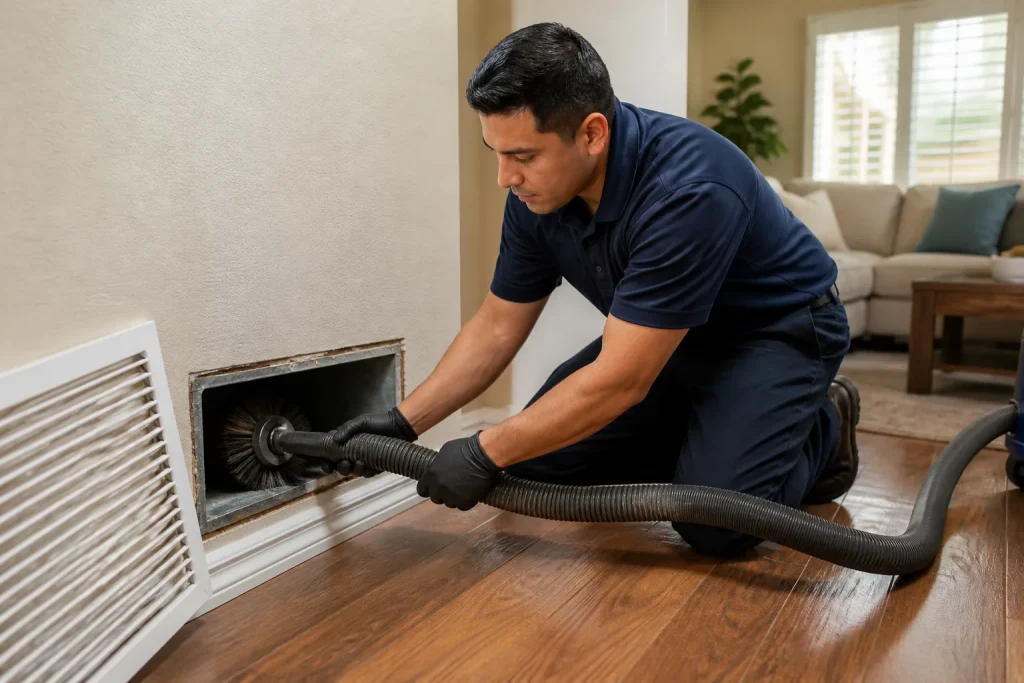
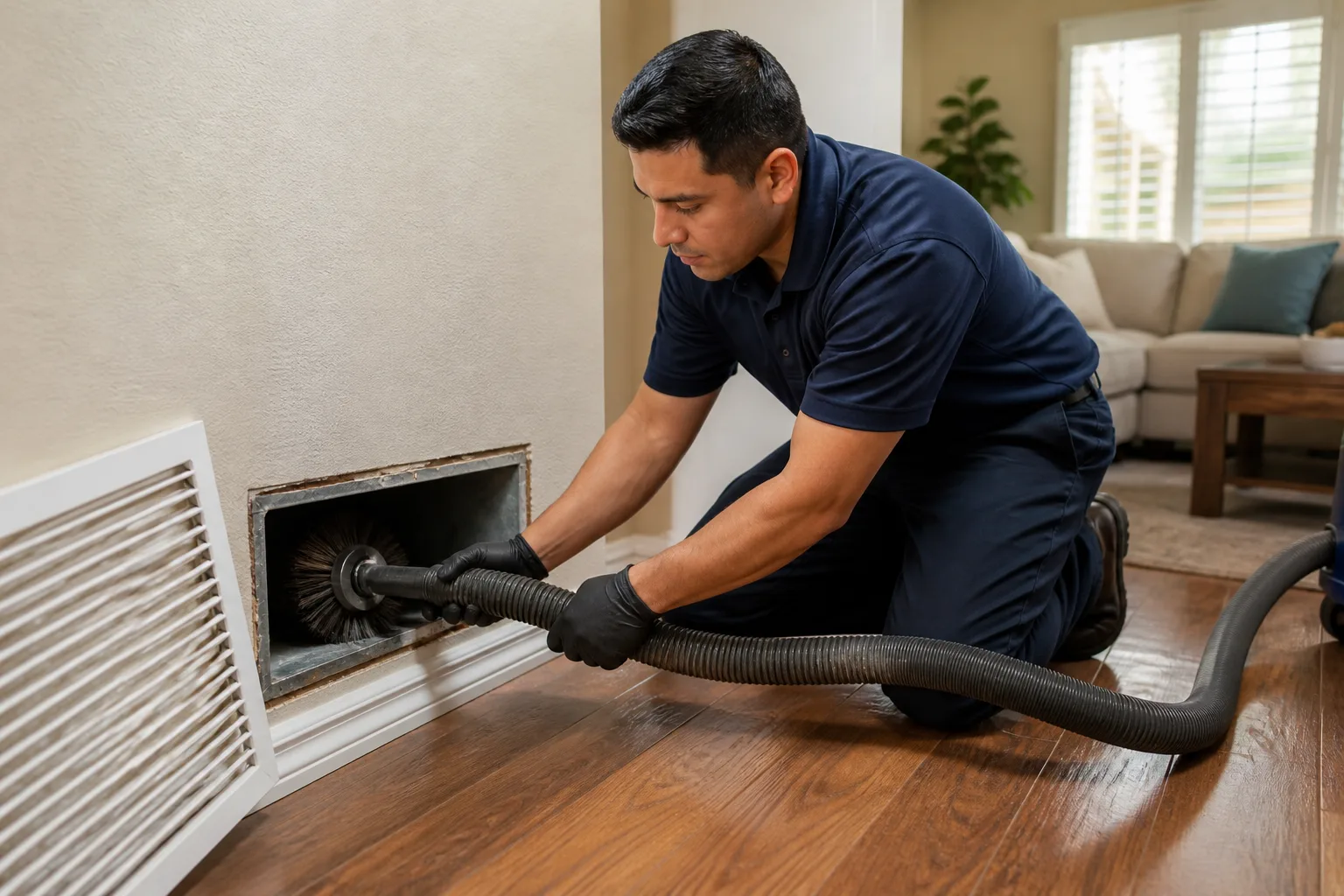
All three are physical faults, and no amount of rotary brushing and Nikro negative-air extraction will undo them. Cleaning addresses contamination. It doesn’t address geometry.
How to Read a Duct Camera Inspection Report
A camera inspection report should tell you two things in plain words: whether the duct is intact, and whether it’s contaminated. Those are separate findings, and the decision comes from pairing them. When we walk a Stanton homeowner through footage, we split the findings into the language below.
“Intact but contaminated.” The ducts hold their shape, joints are sealed, and the liner is sound – but there’s visible buildup, dust staining, or microbial growth on interior surfaces. This is the classic cleaning case. Rotary cleaning plus negative-air extraction, and you’re done.
“Structurally compromised.” The run has a collapse, a disconnect, or delamination. Cleaning won’t make it worse in most cases, but it won’t fix airflow or the leak, so cleaning alone is incomplete. This is where repair, sealing, or partial replacement comes in, followed by cleaning.
“Compromised and contaminated.” Both problems in the same system. The correct order is repair first, then clean – never the reverse.
A report that describes contamination without addressing integrity is only doing half the job. If a quote shows up with a machine and no inspection, you haven’t been told which problem you have.
Air Duct Cleaning vs. Replacement: What It Actually Costs in Stanton
The honest answer is that cleaning a whole system typically costs a fraction of duct replacement, so the choice is rarely “which is cheaper” – it’s “which problem do you have.” A clean, intact system doesn’t need replacement. A compromised system that gets cleaned instead of repaired has paid twice. The ranges below are typical for a Stanton system, in whole-system terms rather than per-vent pricing.
| Scenario | Typical Stanton range | What the job involves |
|---|---|---|
| Full-system air duct cleaning | ~$400 | Rotary brushing all runs, negative-air extraction, register and return work |
| Partial replacement of a failed section | ~$1,800 | Remove and rebuild compromised runs, reseal the system, then clean |
| Full-system duct replacement | Substantially higher than partial | The whole system is structurally compromised, not one zone |
| Duct repair and sealing only | Between cleaning and partial replacement | Seal disconnects and leaks, re-support sagging flex, then clean |
These are estimates, and the written estimate you receive after inspection sets the final price. When cleaning at roughly $400 is the right call, it’s because the ducts are intact – you’re paying for contamination removal, and you get it. When $1,800 of partial replacement is the right call, it’s because the alternative is cleaning a broken system and paying again when airflow still doesn’t improve. If the ducts are intact but the flex has collapsed, a cleaning-only quote is the wrong quote. If a system is fine, a replacement quote is the wrong quote. The report is what tells you which.
Fair pricing shows up in the report, not in the number on the truck. Ours is set per job by the written estimate, with no per-vent surprise.
Stanton Housing Stock: Which Duct Materials Fail, and When
Duct failure isn’t random. It follows the materials that were used in each era of Stanton construction. In our experience walking attics and crawl spaces across Stanton, the pattern is predictable once you know when a house was built.
- Older Stanton homes, built before flex duct became standard. Rigid galvanized steel runs, often with taped or mastic joints. Steel lasts; the joints and insulation wrapping are what degrade. Disconnected trunk lines and deteriorated external insulation are the usual findings.
- Mid-generation housing with early flex duct and duct board. The flex has often sagged between supports or lost its liner, and duct board has had time to delaminate at fittings. Collapsed flex runs and seal failure are common here.
- Newer construction with current flex systems. Usually intact but poorly supported or roughly installed, with flex crushed at tight turns or against joists. Film inspection shows the kinks.
The local climate is gentle, which cuts both ways: less thermal stress on duct board than you’d see in harsher climates, but attics and crawl spaces here still get hot, and heat plus time plus weight is what collapses sagging flex. It’s a slow, invisible process, which is exactly why an inspection is worth the visit. If you’d like a whole-system duct inspection with the cleaning, our air duct cleaning team in Stanton can tell you what you have before anything else gets scheduled.
How Repair and Cleaning Are Sequenced in One Visit
When a system needs both, the order is fixed: structural repair comes first, then cleaning. It’s not a scheduling preference. Cleaning a run before you reconnect it means the debris you just extracted is joined by drywall dust, sealant particles, and any fiber loosened during the repair. You end up cleaning twice. The correct sequence in a single visit looks like this:
- Inspect and mark. The camera walk identifies each failed section, so the repair scope is set before a machine runs.
- Repair and reseal. Replace collapsed flex, rebuild disconnects, re-support sagging runs, reseal the system. Duct board that’s delaminated gets replaced, not patched.
- Clean the whole system. Now rotary brushing and negative-air extraction run on a duct that’s the right shape, so the cleaning actually reaches the rooms.
- Sanitize where it’s warranted. We use Abatement Technologies filtration equipment and hold sanitizing work to Guardsman-grade protection standards, so the treatment is documented rather than sprayed and forgotten.
Kitchen and bath exhaust and dryer vent cleaning can be folded into the same visit if the timing lines up, and a HVAC cleaning pass covers the air handler and coil so the freshly repaired ducts aren’t feeding a contaminated system. That’s the full scope: we clean it, we seal it, we document it, all on the same visit.
When to Call a Pro (and When Not To)
If your ductwork is intact and the only complaint is dust, odors, or allergy symptoms, professional cleaning is the correct next step. It’s also worth a call if your system has Honeywell or Aprilaire whole-home components, since those need to be handled without disturbing the filtration hardware during cleaning. But do not hire a cleaning crew before anyone has looked at duct integrity. That’s the single mistake we see most, and it’s the one that costs homeowners twice.
If you’d rather not climb into the attic with a flashlight and a phone camera, don’t. Our technicians have up to 13 years of experience reading exactly these reports. Call (877) 820-9417. We answer 24/7. Fast dispatch from 7am to 7pm, Sunday through Friday.
The Bottom Line
Cleaning removes contamination from a duct system that’s structurally sound. Repair or replacement fixes a duct system that isn’t. The decision comes from an inspection – not from a price list, and not from a guess. If cleaning is the right answer, you’ll get a cleaning quote. If partial replacement is, you’ll get an honest one, and the cleaning that follows the repair. Anything that skips the inspection step is selling you a service, not a solution. If you’re in Stanton and want a straight answer, Stanton Air Duct Cleaning Pros offers free estimates – call (877) 820-9417. We answer 24/7. Fast dispatch from 7am to 7pm, Sunday through Friday.
For the broader picture of what we do across the full duct system, start with Stanton Air Duct Cleaning Pros.
Frequently Asked Questions
Can I just clean my ducts instead of replacing a collapsed flex run? No. Cleaning removes debris, not a collapse. A crushed flex section has to be replaced to restore airflow; cleaning it just cleans the inside of a constricted tube. Call (877) 820-9417 for an inspection and a free estimate.
How do I know if my duct board has delaminated? Only a camera inspection confirms it. You can look for foil peeling away from the rigid panel at fittings and joints, but a report from a proper inspection is what tells you whether the core is exposed. Call (877) 820-9417 to schedule one.
Does duct cleaning actually cost about $400 in Stanton? That’s a typical whole-system range for cleaning an intact system, with the written estimate setting the final price. If the ducts are compromised, cleaning alone won’t fix airflow. Call (877) 820-9417 for an exact quote – estimates are free.
Can repair and cleaning happen in the same visit? Yes. Structural repair and resealing happen first, then cleaning runs afterward – never the reverse – so the debris from the repair is extracted in the same pass. Call (877) 820-9417 to book it.
Written by the team at Stanton Air Duct Cleaning Pros.
Need Air Duct Cleaning Help?
Call Stanton Air Duct Cleaning Pros - the local pro we connect you with is licensed and insured, here with fast help in Stanton.
(877) 820-9417